
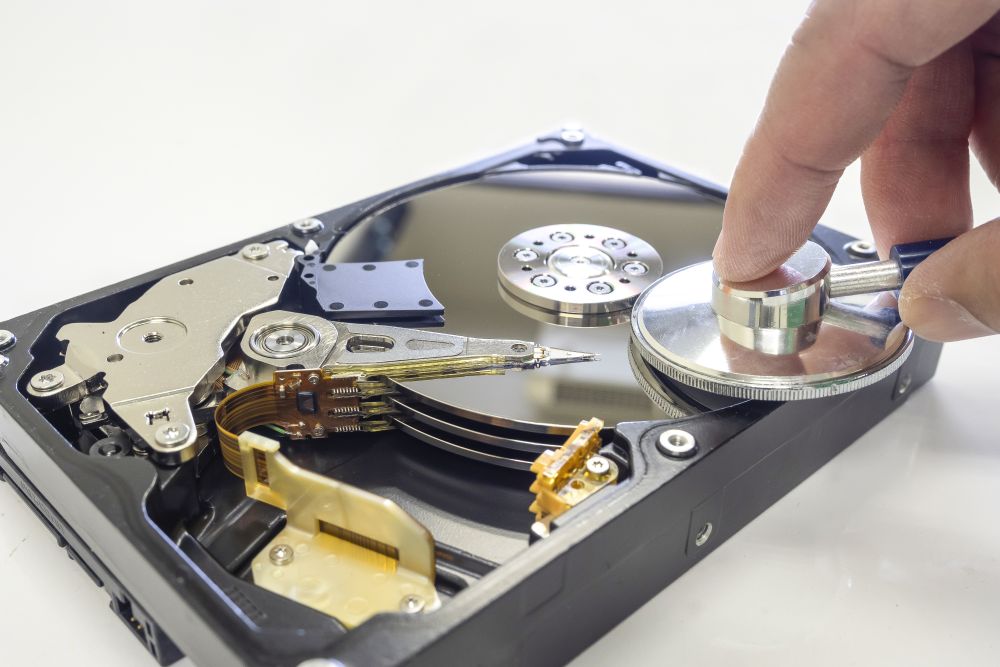
For businesses disposing of retired hard drives, degaussing and physical destruction serve different purposes. Hard disk degaussing uses a powerful magnetic field to erase data stored on magnetic platters, while physical destruction damages the drive through methods such as crushing or shredding. The two can form part of the same disposal process, with physical destruction following degaussing for added assurance. Understanding what happens before, during and after a degaussing service helps businesses plan secure data destruction from collection to final disposal.
What Is Hard Disk Degaussing?
Hard disk degaussing exposes a drive to a powerful magnetic field. Traditional hard drives and backup tapes store data as tiny magnetic patterns on their surface. A degausser scrambles those patterns completely, leaving nothing that recovery software can read.
The process also wipes the servo tracks the drive needs to function, so a degaussed hard drive will not work again. That is the point. The data and the device both reach a definite end.
When Should Businesses Use a Degaussing Service?
A professional degaussing service makes sense whenever magnetic media holds sensitive information and cannot be reused safely. Common situations include:
- Retiring servers, storage arrays or desktop PCs
- Disposing of failed drives that software cannot wipe
- Clearing out old LTO and backup tape libraries
- Closing or relocating an office or data centre
- Meeting audit requirements under the PDPA
One caution matters here. Degaussing only works on magnetic media. Solid state drives, USB sticks and memory cards store data electronically, so they need shredding or crushing instead.
How Hard Disk Degaussing Supports Data Destruction
Good data destruction is about certainty. Software erasure is useful for drives that will be reused, but it depends on the drive working properly. A damaged disk may refuse to wipe, and a partial wipe can leave fragments behind.
Degaussing removes that doubt. Recognised frameworks such as the NIST Guidelines for Media Sanitization list degaussing as a purge method for magnetic media, meaning the data cannot be recovered even with laboratory techniques. For many organisations, that level of assurance is what secure destruction of data really means.
What Happens Before Degaussing?
The work starts well before any drive meets a magnet. A reputable provider will:
- Collect drives in locked, sealed containers
- Record each drive’s serial number on an asset list
- Confirm the media type, so SSDs are routed to a different method
- Maintain a documented chain of custody from your premises onwards
This preparation means every drive can be accounted for, from pickup to final report.

What Happens During the Degaussing Process?
Each drive is placed in a degausser rated for its coercivity, which is the strength of field needed to erase that type of media. The machine discharges a powerful magnetic pulse in seconds. Many providers can run this step at your site, so you can watch it happen.
Degaussing vs Hard Disk Destruction
Degaussing erases the data but leaves the drive physically intact.
Degaussing is for:
- Large volumes of magnetic drives and tapes
- Situations needing fast, on-site erasure
Physical destruction is for:
- SSDs and other non-magnetic storage
- Drives holding the most sensitive or classified data
Many businesses combine the two. Degaussing first and hard disk destruction afterwards gives a visible, irreversible result that reassures auditors and boards alike.
When to Use a Hard Drive Destruction Service
A hard drive destruction service is the right choice when you hold various different types of storage media, when policy requires visible destruction, or when the data is too sensitive to rely on one method alone.
Ask whether the provider can perform on-site physical destruction, what method is used, and whether you will receive a certificate listing each serial number. For example, TD ITAD provides on-site crushing for hard disks, while shredding may not be available on-site. A specialist hard drive destruction service should clearly explain the available method, process and documentation before the job begins.
How Secure Hard Disk Disposal Works After Destruction
Destruction is not the final step. Secure hard disk disposal also involves the responsible handling of materials left behind after physical destruction , including metal fragments, circuit boards and casings. These materials should be directed through appropriate disposal channels rather than treated as general waste.
Businesses should also receive a certificate of destruction, matched to your asset list. This provides an important audit trail if a regulator or client ever asks. Proper secure hard disk disposal completes the process on both data security and environmental responsibility.
Why Choose TD ITAD for Media Destruction Services
TD ITAD provides media destruction services for government ministries, statutory boards and private companies across Singapore. Its team handles degaussing, physical shredding and data sanitisation under a documented chain of custody.
The company is an NEA licensed General Waste Collector Class A and holds ISO 9001, ISO 14001, ISO 45001, NEA SS 587 and bizSAFE Star credentials. Every job ends with a certificate of destruction, so your media destruction services leave a clear audit trail.
FAQ
Can data be recovered after degaussing?
No. A properly rated degausser erases magnetic data permanently, and the drive itself stops working.
Does degaussing work on SSDs?
No. Degaussing uses a powerful magnetic field to erase data from traditional hard drives. SSDs store data on memory chips instead of magnetically, so degaussing does not work on them. Physical destruction is an effective alternative.
Can degaussing be done at my premises?
Yes. TD ITAD offers on-site degaussing services, allowing your team to witness the process and ensuring sensitive data is securely sanitised before the drives leave your premises.
Do I need both degaussing and shredding?
Not always, but combining them gives the highest assurance for sensitive data. Speak to a hard disk degaussing specialist to determine the most suitable approach for your organisation’s security requirements.
