

Every office has one. A storeroom stacked with retired laptops, a cabinet of old hard drives, or a rack of servers that went quiet after the last upgrade. Most of that hardware still holds data, and in Singapore, how a business lets go of it carries real legal and reputational weight. Choosing the right IT asset disposal services is how companies close that chapter safely.
This guide explains what a proper service should cover, how to judge providers, and where businesses tend to slip up.
What Are IT Asset Disposal Services?
IT asset disposal services manage the end of life of business technology. That covers collection, data erasure, asset valuation, recycling and the paperwork that proves each step happened.
The aim is simple: no readable data leaves the building and no hardware ends up in landfill. A good provider treats each device as a record to be tracked, not as scrap to be cleared.
Why Secure IT Disposal Services Matter for Businesses
A single unwiped drive can expose customer records, payroll files or contracts. Under the Personal Data Protection Act, organisations must make reasonable security arrangements for personal data, right up to the point of disposal. The Personal Data Protection Commission sets out practical steps in its guide to data protection practices for ICT systems.
Secure IT disposal services turn that obligation into a repeatable process. They give IT, compliance and procurement teams evidence they can show an auditor, rather than a verbal assurance that the job was done.
What Should Be Included in an IT Disposal Scope?
A clear scope protects both sides. Before signing, check that the following are written into the agreement.
Security and data handling
- On-site or off-site data erasure using recognised standards
- Shredding or degaussing for failed or sensitive drives
- A documented chain of custody from pickup to final processing
Logistics and value recovery
- Scheduled collection with sealed, tracked transport
- Valuation of equipment that can still be resold
- Responsible recycling for items that cannot be reused
Documentation
- Serialised asset reports listing every device received
- Certificates of erasure, destruction and disposal
- Records that support PDPA and environmental audits
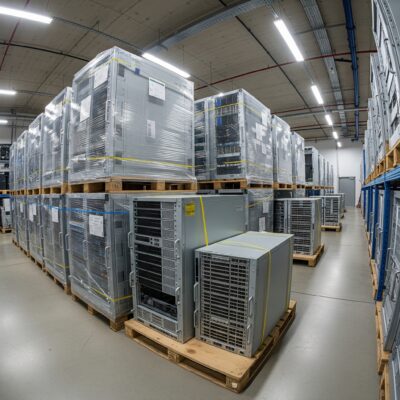
Computer Disposal Services vs General E-Waste Disposal
General e-waste collection focuses on recycling materials. It rarely deals with the data stored inside a machine. Certified IT asset disposition (ITAD) solutions go further, because they treat each laptop, desktop and server as a data-bearing asset first and a recyclable item second.
The difference shows up in the paperwork. E-waste disposal may give you a weight receipt. Certified IT asset disposition (ITAD) solutions should give you a device-level report and a certificate confirming the data was erased. Our guide to computer disposal services explains how offices can prepare.
How to Compare IT Asset Disposal Vendors
Not all IT asset disposal vendors work to the same standard. When building a shortlist, ask each one the same questions:
- Are you licensed by NEA to collect and handle e-waste?
- Do you hold ISO 9001, ISO 14001 and ISO 45001 certification?
- Does your process align with NEA SS 587 for end-of-life ICT equipment?
- Can you provide serial-level reports and destruction certificates?
- How do you handle assets that fail data erasure?
Strong IT asset disposal vendors will answer every question above in writing, without hesitation.
When Should Businesses Arrange IT Hardware Disposal?
The best time is before equipment starts to pile up. Bring in an ITAD company when you face:
- A company-wide laptop or desktop refresh
- Data centre consolidation or server decommissioning
- Office relocation, closure or downsizing
- Mergers that leave duplicate equipment
- Leased equipment reaching the end of its term
Involving an ITAD company at the planning stage, rather than after the refresh, keeps storage costs down and closes security gaps sooner.
Common Mistakes to Avoid During IT Disposals
Many IT disposals go wrong for ordinary reasons. Watch out for these:
Relying on factory resets.
A reset does not reliably remove data from modern drives.
Leaving devices in storage for months.
Idle hardware is easy to lose track of.
Skipping the asset list.
Without one, you cannot match what left the office to what the vendor reports.
Accepting a certificate with no serial numbers.
It proves very little.
Forgetting smaller items.
USB drives, phones and printer hard disks hold data too.
Well-run IT disposals follow a written process, assign an owner and finish with documents filed away for audit.
Why Choose TD ITAD for Secure IT Asset Disposal
TD ITAD is a trusted name for IT asset disposal in Singapore, serving government ministries, statutory boards and private-sector firms. The company is an NEA licensed General Waste Collector Class A and holds ISO 9001, ISO 14001, ISO 45001, NEA SS 587 and bizSAFE Star credentials.
Its service covers data erasure, drive shredding, collection and recycling, each backed by a certificate. For organisations that want IT asset disposal in Singapore with full documentation, TD ITAD offers secure IT disposal services that stand up to scrutiny.
FAQ
How long does the IT disposal process take?
Most collections can be scheduled within days. Processing time depends on volume and whether on-site secure media destruction is required.
Can disposed equipment still have value?
Yes. Working devices can often be wiped and resold, offsetting the cost of the service.
Do I need a certificate for every device?
You should receive a report listing each serial number, along with a certificate covering the batch. This is your proof of compliance.
Are IT asset disposal services suitable for small businesses?
Yes. Small firms handle personal data too, and the same PDPA duties apply. Choosing the right IT asset disposal services protects your data, your customers and your reputation.
